By the time the market opens, the best spots are already loud.
Not loud in volume—loud in presence.
The stalls that win attention don’t always have the biggest budgets. They have the clearest identity. They look like a brand, not a person selling things. And in an outdoor market, where everyone is competing against sun glare and distractions and the smell of coffee drifting from three directions, being “good” isn’t enough.
You have to be obvious.
A small business owner—let’s call her Mia—learned that the hard way. Her product was excellent. Her regular customers loved it. But at weekend markets, she blended in. Her setup was functional: a borrowed gazebo, a hand-painted sign, a table with a cloth that never quite sat straight. It worked… but it didn’t pull.
People walked past without realizing what they were missing.
After one especially slow Saturday, she watched a line form at a stall two rows over. The product wasn’t better. The stall just looked like it belonged on a poster. A clean tent. Tall flags. Perfectly fitted table covers. Staff who weren’t scrambling with clips and tape.
That’s when she decided: next weekend, she’s not just bringing stock. She’s bringing a storefront.
Building a market setup like a premium brand
Mia didn’t want “cheap and cheerful.” She wanted premium quality that would last through early mornings, rough bump-ins, and unpredictable weather. Something that would look good from a distance and still look good up close—because customers do both: they notice you far away, then they judge you right at the table.
So her kit centered on three heroes:
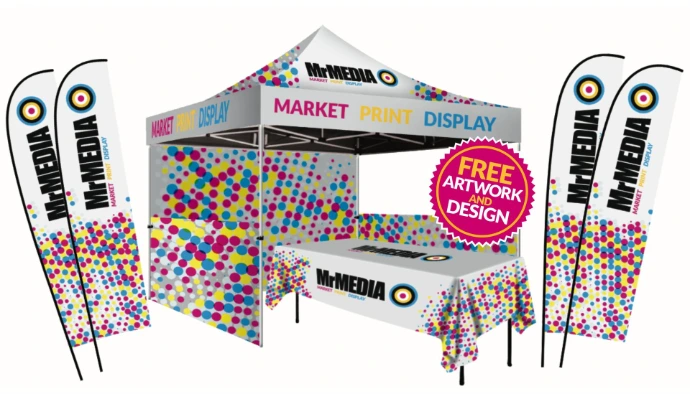
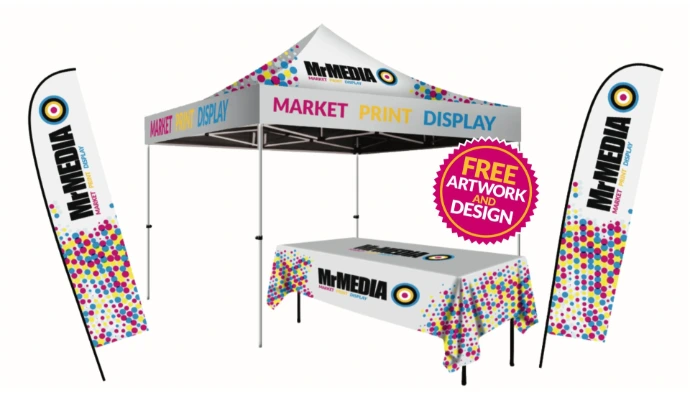
- World’s Toughest 10 x 10' Tent to create a professional home base
- Telescopic flags to do the long-range attraction
- Branded tablecloths to make the product table look intentional and clean
The change was immediate—not because people suddenly liked her product more, but because they finally saw her.
The difference between “set up” and “arrive”
There’s a moment every market vendor knows. The moment where you step back, look at your stall, and realize whether you’ve arrived—or whether you’re just occupying space.
Under the tent, Mia’s brand lived in one place. The canopy acted like a sign you couldn’t miss. The flags reached above head height and pulled eyes in from down the aisle. The tablecloths did the quiet work: removing visual clutter so the product could be the hero.
Everything looked aligned. Like a real business. Like something worth walking toward.
And customers responded in the simplest way: they slowed down.
They didn’t just glance. They paused.
They asked questions. They took photos. They remembered the name.
Premium quality shows up in the middle of the day
At 1:00 p.m., markets hit their messy phase. Sun shifts. Wind picks up. People spill drinks. Kids bump tables. Vendors get tired. Corners droop. Signs fall over.
This is where the premium setup started paying for itself.
The tent held its shape. The flags stayed readable. The table presence remained crisp even after hours of traffic. Mia wasn’t constantly fixing her stall. She was selling.
That’s the hidden ROI: premium quality doesn’t just look better. It frees up energy. It reduces the “background stress” that steals attention from customers.
The outcome that matters to small business
Mia didn’t just have a better Saturday. She built an asset.
A setup she can deploy week after week—outdoors, in mixed conditions—while staying consistent in photos and in person. That consistency becomes reputation. Reputation becomes repeat customers. Repeat customers become growth.
And when she eventually upgrades to bigger events or partners with other vendors, she won’t be starting over. She’ll already look like the brand she’s becoming.
If you’re serious about markets, festivals and outdoor selling, stop treating your setup as “equipment.” Build it like a premium storefront: tent, flags, table presence—designed to be seen and built to last.